
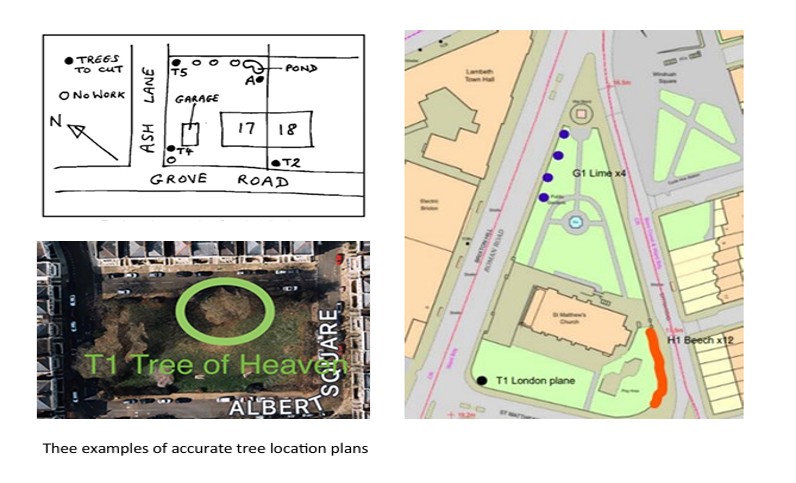
Your application or notice must include a plan showing exactly where the tree is located. The plan can be a printed map, a hand-drawn sketch, or a screenshot from an online map. It must show enough nearby roads, buildings and surrounding land for the tree's location to be clearly identified.
Each tree or group of trees should be labelled as follows:
- T = an individual tree (for example, T1 Oak)
- G = a group of trees (for example, G1 Oak x3, Beech x1, Lime x2)
- H = a group of trees forming a hedge (for example, H1 Leyland Cypress x7)
The plan should clearly show:
- Property boundaries
- Nearby properties, including house names or numbers
- Road names
- The location of each tree or group of trees
Where possible, the plan should be drawn with north at the top. If this is not possible, please include a north arrow.
If some trees on a site are protected by a Tree Preservation Order (TPO) and others are only protected because they are in a Conservation Area, you must submit separate applications.
You would need to:
- Submit a TPO application for work to trees protected by a Tree Preservation Order.
- Submit a Section 211 notice for work to trees protected by their Conservation Area status.
These must not be combined into a single application because they are dealt with under different legal requirements.
If a TPO application and a Section 211 notice are submitted on the same form, we will be unable to validate or register the application and it will be returned to the applicant.